

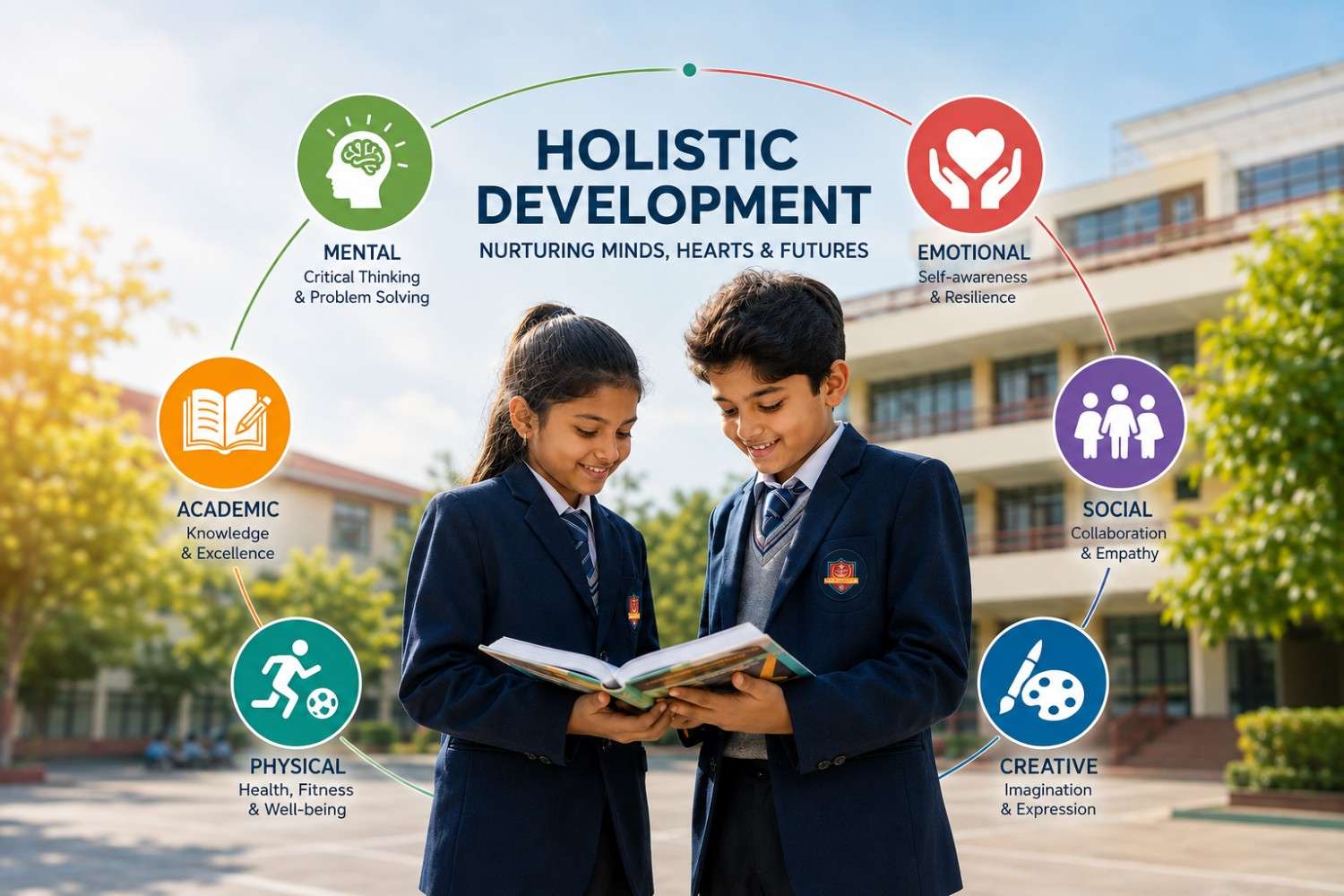
Holistic development in education means developing a child's mind, body, emotions, social skills, creativity, and values together — not just academic marks. Instead of measuring a child by exam scores alone, holistic education treats intellectual, physical, emotional, social, creative, and moral growth as equally important, connected parts of the same person. A child who scores well but cannot handle failure or work in a team has only grown in one direction — and that imbalance tends to show up later in life, not on a report card.
This guide explains what holistic development means, why it matters, what it looks like inside a classroom, and how parents can identify a school that genuinely practises it — including how Bajrang International School (BIS), Greater Noida West, a CBSE school for Pre-Nursery to Class VIII, builds its school day around this philosophy.
The 6 Areas of Holistic Child Development
Holistic development rests on six interconnected areas of growth. None work well in isolation — a child who is academically strong but emotionally unsupported is still developing unevenly.
- Intellectual/Cognitive – reasoning, curiosity, problem-solving, and academic knowledge
- Physical – fitness, motor skills, coordination, and healthy daily habits
- Emotional – self-awareness, resilience, and managing feelings constructively
- Social – teamwork, empathy, communication, and conflict resolution
- Creative – imagination and self-expression through art, music, or invention
- Moral/Ethical – integrity, discipline, and a grounded sense of right and wrong
A purely academic model develops mostly the first area, often at the expense of the rest. A holistic model develops all six side by side, since real life never asks a person to use just one skill at a time — a job interview, a friendship, or a tough exam all draw on several of these areas together.
Why Holistic Development Matters in Today's Education
Marks alone don't predict life success. Employers and universities increasingly value communication, adaptability, and emotional intelligence over the ability to memorize information. A transcript full of A grades says little about whether a young adult can collaborate, adapt, or lead.
Mental health depends on balance. Children under constant academic pressure, with no outlet for play or emotional expression, are more prone to anxiety, burnout, and disengagement from learning altogether.
Future careers demand adaptability. Many of today's most in-demand jobs didn't exist a decade ago. Schools that build creativity and critical thinking prepare children for careers that haven't been invented yet.
Character can't be looked up. Facts are searchable in seconds. Integrity, empathy, and resilience are not — they're shaped slowly, through years of consistent, values-based experience.
What Holistic Development Looks Like in a Real Classroom
It's easy to describe holistic development in theory; it looks quite different in daily practice. A school that genuinely practises it typically includes:
- Activity-based learning, where children learn concepts by doing, building, and experimenting rather than only listening and copying notes
- Daily sports and physical education, built into the timetable as a core subject rather than an occasional break from "real" classes
- Arts, music, and drama with genuine curriculum time each week, not confined to a once-a-year annual function
- Life skills and leadership opportunities — public speaking, student councils, group projects, and house-based competitions
- Small class sizes, so teachers can actually notice when a child is struggling silently, or gifted in something the syllabus doesn't test
- A values-driven daily culture, reinforced through assemblies, discipline, and how students are expected to treat each other — not confined to a single textbook chapter on "good habits"
When these elements exist together, consistently, a child experiences holistic growth as a lived daily rhythm rather than an occasional activity squeezed in around academics.
How to Identify a School That Actually Practises Holistic Education
Because "holistic development" now appears in almost every school's marketing material, parents need a way to separate genuine practice from a buzzword. A few practical checks help:
- Ask about the daily timetable. Sports, library time, and co-curricular activities should appear every single day — not occasionally, and not only in the years leading up to board exams.
- Check class strength. Individual attention becomes nearly impossible once a classroom crosses 35–40 students, no matter how good the philosophy sounds on paper.
- Verify facilities in person. Labs, a functioning library, sports grounds, and dedicated art or music spaces should be visibly used by students, not just photographed for the prospectus.
- Talk to current parents. Ask what their child actually does after 2 PM on a normal school day. If the honest answer is "more textbook work," the school is academic-first with holistic language attached — not truly holistic.
How Bajrang International School Applies Holistic Development
This is exactly the philosophy behind Bajrang International School (BIS), Greater Noida West — a CBSE school educating children from Pre-Nursery to Class VIII. Rather than treating holistic development as a marketing phrase, BIS structures the actual school day around it, from the first bell to the last:
- Mornings begin with a student-led assembly, setting a reflective, confidence-building tone before academics start
- Hands-on lab sessions — from robotics kits to science experiments — run from Grade IV onward
- Structured sports periods are led by certified coaches, with inter-house tournaments in cricket, football, basketball, and athletics
- Afternoons include arts, music, and supervised library time, drawing from a 20,000-title collection and digital reading corner
- Class sizes are capped at 28 students, so teachers can notice not just marks but a child's confidence, creativity, and emotional growth
Set across an 8-acre campus with smart classrooms and modern labs, this structure reflects a simple belief: a school's job isn't only to prepare children for exams, but to prepare them for everything that comes after — university, careers, relationships, and the ordinary challenges of adult life.
Frequently Asked Questions: Holistic Development in Education
Q1. What is holistic development in education?
Educating a child's mind, body, emotions, social skills, creativity, and values together, not just academics.
Q2. Why is holistic development important for children?
It builds real-life skills like resilience, teamwork, and adaptability — not just exam performance.
Q3. What are the 6 areas of holistic development?
Intellectual, physical, emotional, social, creative, and moral development, growing together.
Q4. How is holistic education different from traditional education?
Traditional education focuses on academics; holistic education balances academics with activities and values.
Q5. Does holistic development affect exam results?
No — it supports focus, confidence, and wellbeing, which often improves academic performance too.
Q6. Which school follows holistic development in Greater Noida West?
Bajrang International School (BIS) follows a holistic model from Pre-Nursery to Class VIII.
The Bottom Line
Holistic development in education isn't a passing trend — it's a return to what education was always meant to do: raise capable, grounded, well-rounded human beings, not just skilled test-takers. When evaluating a school for your child, look past the buzzwords in the brochure and ask how the philosophy actually shows up in a normal school day — in the timetable, the class sizes, the facilities, and the everyday culture. A child who grows academically, physically, emotionally, socially, and morally in balance isn't just better prepared for board exams. They're better prepared for everything that comes after.
Bajrang International School (BIS) is a CBSE school in Greater Noida West offering education from Pre-Nursery to Class VIII, focused on activity-based learning, technology-integrated education, and holistic student development. Admissions for 2026–27 are open.