

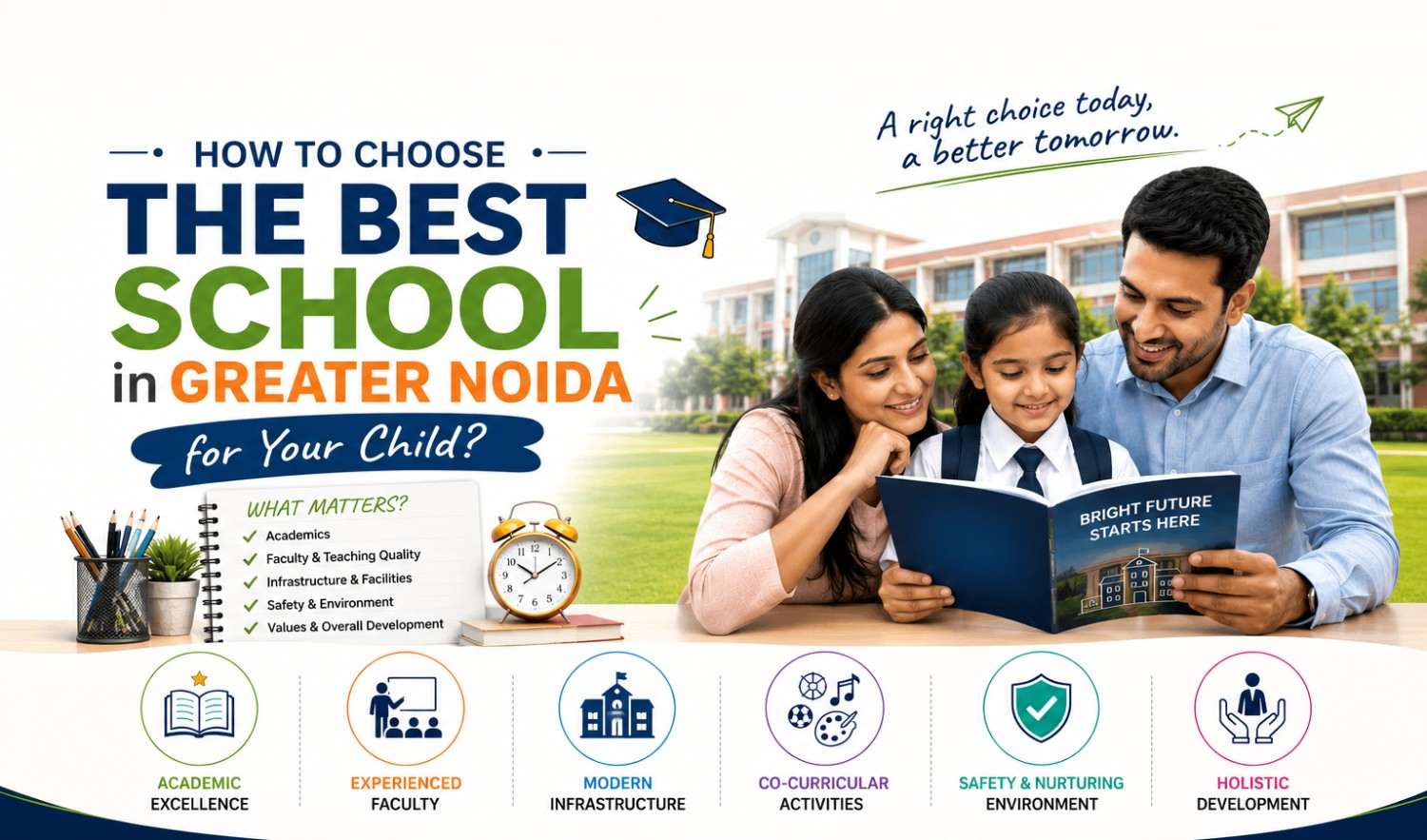
Every parent in Greater Noida has, at some point, sat with a list of school names and felt completely stuck. The area has expanded so quickly that new schools keep opening every year, each one claiming to be the "best" in the same breath. So how do you actually tell the difference between a school that markets itself well and a school that genuinely delivers for your child? The honest answer is that you have to look past the brochures and dig into the details that actually shape a child's daily life — and once you do, some schools clearly stand out more than others.
Here's a practical framework for making that decision, using real questions you should be asking at every school you visit.
1. Does the School Have a Long-Standing Track Record?
A school's age isn't just a number — it tells you how much the institution has been tested, refined, and trusted by generations of families. A school with 20-plus years of experience has usually gone through several cycles of curriculum updates, infrastructure upgrades, and leadership learning that a five-year-old institution simply hasn't had the chance to go through yet.
Bajrang International School, for example, carries a legacy of 27 years in the region — a track record that has allowed it to continuously refine its academic philosophy while staying rooted in strong values. That kind of longevity is worth factoring into your decision, because it usually reflects consistency rather than a school still figuring itself out.
2. Is the Learning Approach Genuinely Modern, or Just Marketed That Way?
Almost every school today claims to have "smart classrooms" and "technology-integrated learning." The real test is whether that translates into what happens in the classroom every single day. Ask specific questions: How often do students actually use robotics kits or lab equipment? Is technology a genuine teaching tool, or a one-time showcase for the admission brochure?
Schools like Bajrang International School build activity-based and technology-enabled learning directly into the weekly timetable — with lab sessions starting from Grade IV onward — rather than treating it as an occasional event. That consistency is what actually builds a child's curiosity and confidence over time, not a single robotics demo during an open house.
3. How Much Individual Attention Will Your Child Actually Get?
This is one of the most overlooked factors, and arguably one of the most important. A brilliant curriculum means very little if a teacher is managing 45 students in one classroom. Ask directly about class strength. Schools that deliberately cap their class sizes — Bajrang International School keeps this at a maximum of 28 students per class — are making a structural choice to prioritize individual attention over sheer enrolment numbers. That single decision affects everything from how quickly a struggling student gets noticed to how comfortable a shy child feels raising their hand.
4. Does the School Offer More Than Just Academics?
A well-rounded education is built on more than textbooks and exams. Look for schools that treat sports, arts, music, and life skills as core parts of the week, not optional extras squeezed in when time allows. At Bajrang International School, certified coaches run structured sports periods with inter-house tournaments in cricket, football, basketball, and athletics, alongside a genuine cultural calendar for music, dance, and drama. This kind of consistent exposure is what helps children discover their strengths outside the classroom — and it often shapes their confidence far more than an extra mark on a report card.
5. What Does the Campus and Infrastructure Actually Offer?
Numbers on a website mean little until you see them in person. Ask about the size of the campus, the quality of science labs, and whether the library is a living space students actually use. Bajrang International School, for instance, operates from an 8-acre green campus with a 20,000-title library and a digital reading corner — details that matter because they directly shape a child's day-to-day learning environment, not just the photographs used for marketing.
6. Is the Campus Genuinely Safe?
No academic reputation matters if you're not confident about your child's physical safety. Ask about CCTV coverage across the campus, staff verification processes, and whether school transport is GPS-tracked. A safe campus isn't just a feature to check off — it's the baseline that allows everything else, from academics to extracurriculars, to actually matter.
7. What Do Existing Parents Actually Say?
Admissions teams are, understandably, trained to present their school positively. The more reliable source is parents who are already sending their children there. Ask them what they didn't expect, both good and bad, after enrolling. Do teachers know each child by name? Is communication proactive, or do parents have to chase the school for updates? Testimonials on a website are a starting point — parents of students currently at Bajrang International School, for instance, often highlight how closely teachers track each child's individual growth, which is a strong signal of a school culture that goes beyond paperwork.
Bringing It All Together
Choosing the right school for your child in Greater Noida doesn't come down to a single ranking or a single feature — it comes down to how well a school performs across all of these areas together: academic depth, individual attention, extracurricular exposure, infrastructure, safety, and honest parent feedback. Schools that consistently check these boxes, like Bajrang International School, tend to be the ones families stay loyal to for years, not just the ones that look good in a single brochure.
Take the time to visit campuses, ask direct questions, and trust what you observe over what you're told. Your child's school years are foundational — the extra effort at the decision stage is always worth it.
Frequently Asked Questions
1. Why does a school's experience or legacy matter?
A school with a long-standing track record, like Bajrang International School's 27 years in the region, has typically refined its academic approach and infrastructure over time through real experience, rather than still being in an early, untested phase.
2. What is an ideal class size for effective learning?
A class size of around 25–30 students, such as the maximum of 28 students per class followed at schools like Bajrang International School, allows teachers to give meaningful individual attention to every child.
3. How can I tell if "technology-integrated learning" is real or just marketing?
Ask how often students actually use labs, robotics kits, or digital tools in a normal week, and from which grade this begins. Schools that build this into a regular timetable — rather than showcasing it only during admissions season — are more likely to deliver genuine value.
4. Are extracurricular activities really that important?
Yes. Structured sports, arts, and cultural programs, run consistently through the week rather than occasionally, play a major role in building a child's confidence and social skills alongside academic learning.
5. What safety measures should I specifically ask about?
Ask about CCTV coverage, staff background verification, GPS-tracked school transport, and emergency response protocols. A transparent school will answer these questions clearly during your visit.