

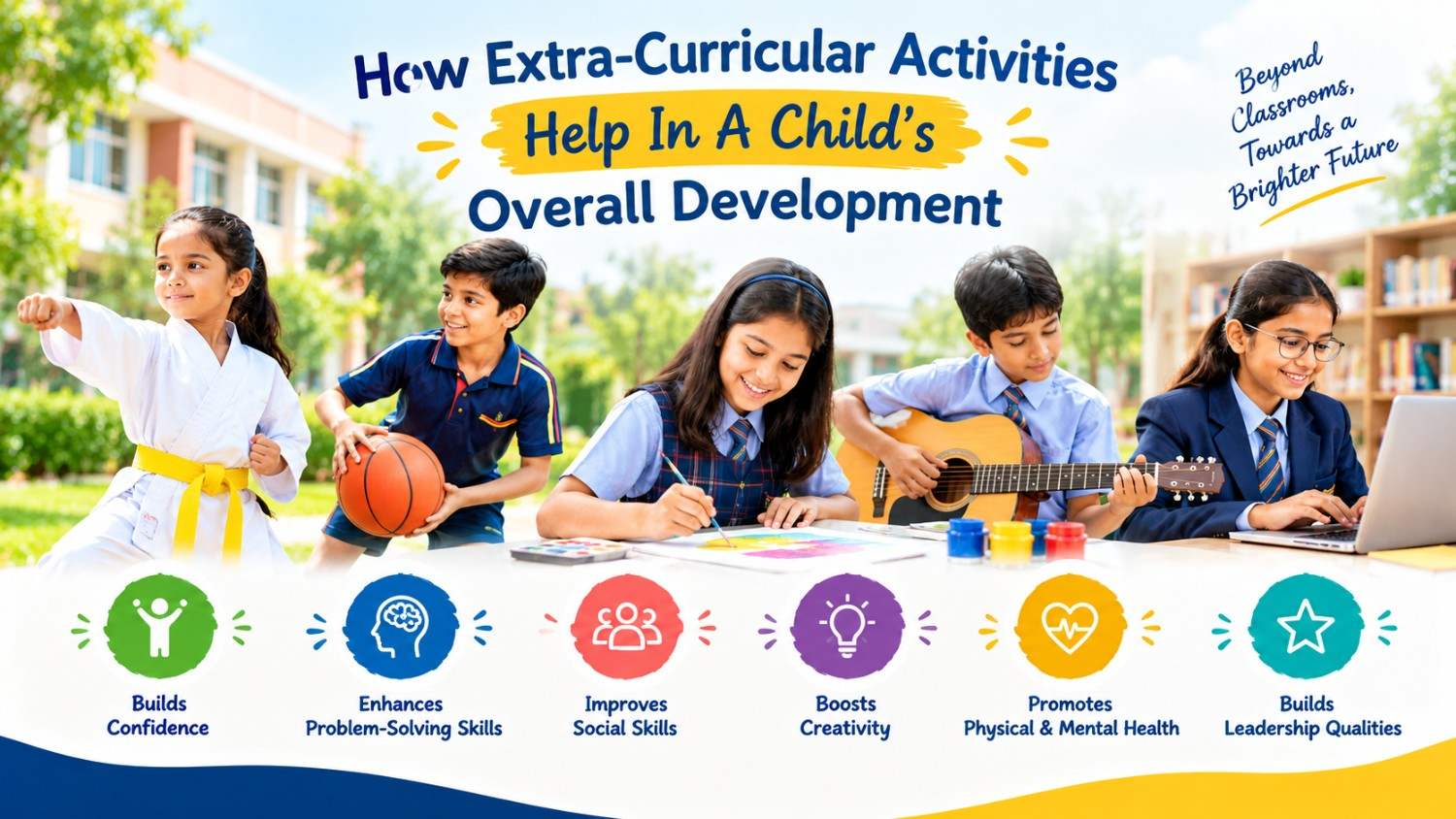
Quick answer: Extra-curricular activities help a child's overall development by building physical health, confidence, teamwork, creativity, time management and emotional resilience. They give children a chance to practise real-life skills that classroom lessons alone cannot teach, and they help children discover what they are good at and what they enjoy.
Key takeaways
- Activities such as sports, music, art, drama and clubs develop the whole child, not just the academic side.
- The World Health Organization recommends that children aged 5 to 17 get an average of at least 60 minutes of moderate to vigorous physical activity every day.
- India's National Education Policy 2020 says there should be no hard separation between curricular and extra-curricular learning.
- One or two activities at a time is a healthy starting point for most children.
- Balanced well, activities support studies instead of competing with them.
What are extra-curricular activities?
Extra-curricular activities are activities children do outside core academic subjects such as maths, science and languages. They include sports, music, dance, drama, painting, debate, chess, robotics, eco clubs and community service.
You will also hear the term co-curricular activities. In everyday school language the two mean nearly the same thing. Co-curricular activities are usually planned by the school and run alongside the syllabus, while extra-curricular activities can be anything a child pursues out of interest. What matters for a parent is not the label but the experience the child gets.
How do extra-curricular activities help a child's overall development?
They develop the parts of a child that textbooks do not reach: the body, the emotions, social skills and creative thinking. A child who plays a team sport, performs on stage or works on a club project is practising communication, patience, planning and problem solving in real situations.
The table below shows where each type of activity makes the biggest difference.
| Type of activity | Examples | What the child develops |
| Sports and fitness | Cricket, football, basketball, athletics, yoga, taekwondo | Strength, stamina, discipline, sportsmanship, handling wins and losses |
| Music and dance | Vocal, instrumental, classical, folk, contemporary | Rhythm, memory, expression, confidence, cultural awareness |
| Visual arts and craft | Painting, sculpture, craft | Creativity, patience, fine motor skills, imagination |
| Drama and public speaking | Theatre, debate, MUN | Communication, empathy, quick thinking, stage confidence |
| Science and technology clubs | Robotics, science club, entrepreneurship | Curiosity, logic, innovation, teamwork on projects |
| Community and nature clubs | Eco club, service projects | Responsibility, social awareness, care for others |
| Mind games | Chess, quizzes | Strategy, concentration, planning ahead |
The eight benefits, explained
1. Do extra-curricular activities improve physical health?
Yes. Regular sport, dance and yoga improve fitness and build healthy habits. Children who move more tend to feel more energetic and return to class more alert. Our guide on which school in Greater Noida West offers the best sports facilities explains what a good sports programme looks like.
2. Do they build confidence?
Yes. Confidence grows from doing something difficult and getting through it. Performing on stage, taking a penalty or presenting an idea in a club gives a child a small, real success. Those successes add up to a lasting belief in their own ability.
3. Do they teach time management?
Yes. A child with practice at 4 pm and homework to finish learns that time has to be planned. Nobody has to lecture them. The schedule itself teaches prioritising, which is a skill many adults still struggle with.
4. Do they improve teamwork and social skills?
Yes. On a team or in a group project, no child can succeed alone. They learn to listen, share credit, accept mistakes and settle disagreements calmly. These habits carry into classroom group work now and the workplace later.
5. Do they make children more creative?
Yes. Art, music, drama and building clubs reward trying ideas that have no single correct answer. A child painting a scene or designing a small robot has to experiment, fail and adjust, which is the basis of creative thinking.
6. Do they build emotional resilience?
Yes. Losing a match or missing a note teaches a child that disappointment is survivable. Small setbacks in a safe setting prepare children for bigger ones later.
7. Do they affect academic performance?
When balanced well, they support it. The discipline from training or rehearsal carries into homework, and curiosity from a science or literary club makes lessons feel more interesting. The WHO's review of the evidence also links physical activity with better cognitive outcomes in school-age children. For a wider view, read our article on what holistic development in education means.
8. Do they help a child find their passion?
Yes. A child cannot love something they have never tried. A wide range of activities lets them sample until something clicks. For some it becomes a hobby, for others the first step towards a career in sport, design, science or public speaking.
What do NEP 2020 and WHO say about activities?
India's National Education Policy 2020 treats activities as part of learning, and the WHO sets a daily activity target for children. Both point in the same direction.
- NEP 2020: The policy states there should be no hard separation between curricular, extra-curricular and co-curricular activities, or between arts, sciences and sports. It also promotes sports-integrated and arts-integrated learning so that physical activity and creativity become part of everyday teaching.
- World Health Organization: Children and adolescents aged 5 to 17 should do an average of at least 60 minutes of moderate to vigorous physical activity daily. Its guidelines link regular activity with better fitness, mental health and cognitive outcomes.
For schools following the CBSE curriculum, this means that sport, art and music are not "extras" to be squeezed in after studies. They are part of how children are meant to learn.
Which activity suits which child?
The best activity is usually the one a child chooses and wants to keep doing. These pairings are starting points, and children often surprise us.
| If your child is | They may enjoy |
| Full of energy | Athletics, football, basketball, taekwondo |
| Quiet and thoughtful | Painting, music, chess, a reading or writing club |
| Talkative and expressive | Drama, debate, Model UN |
| Always taking things apart | Robotics, science club |
| Caring about people and nature | Eco club, community service |
| Fond of rhythm and movement | Dance, vocal or instrumental music |
How many extra-curricular activities are too many?
One or two at a time is a good starting point for most children. Add more only when the child asks for them and still has time to rest, play and study without stress.
Follow these five steps to set up a healthy routine:
- Listen first. Ask what looks fun to your child, not what looks impressive on a certificate.
- Start small. Pick one or two activities and see how the week feels.
- Give it a fair trial. Most activities feel awkward at first, so aim for at least a month before deciding.
- Protect free time. Rest and unstructured play are part of development too.
- Praise effort. Children who are praised for trying stay motivated longer than those praised only for winning.
Signs that a schedule is too full include constant tiredness, falling interest in activities they used to enjoy, and stress around homework.
What to look for in a school
A good school gives every child a chance to take part, not only the best performers. When you visit, ask these questions:
- How many activities are offered, and can every child join?
- Are coaches and instructors trained in their field?
- Is there proper space and equipment, such as a ground, labs, a library and a music room?
- Does the school hold events, inter-house matches and inter-school competitions?
- Are class sizes small enough for teachers to notice a child's hidden talent?
Our article on how to choose the best school in Greater Noida for your child covers more of these points.
Extra-curricular activities at Bajrang International School, Greater Noida West
Bajrang International School (BIS) is a CBSE school in Greater Noida West for students from Pre-Nursery to Class VIII, and it offers more than 25 co-curricular activities. Our Student Life programme is built so that each child can try, stumble, try again and find at least one passion to call their own.
| What | Details |
| Sports | Cricket, football, basketball, volleyball, athletics, table tennis, chess, taekwondo and yoga with certified coaches |
| Arts and music | Vocal and instrumental music, visual arts, painting, sculpture and craft |
| Dance and drama | Classical, contemporary and folk dance, plus theatre |
| Clubs | Eco, literary, robotics, debate, photography, MUN and entrepreneurship |
| Trips and competitions | Curriculum-linked field trips, heritage walks, science expeditions, olympiads, inter-school championships and hackathons |
| Campus | 8-acre green campus with a sports ground, science labs, smart classrooms and a library of over 20,000 titles |
| Class size | Maximum 28 students per class |
| Location | Patwari, Sector-02, Greater Noida West, Uttar Pradesh 203027 |
You can look around in our campus and facilities page and photo gallery, read about recent wins on the Achievements page, learn how lessons and activities fit together on our Academics page, or see why families choose BIS.
Admissions for Nursery to Class VIII are open for 2026-27. You can apply through our admissions page or contact us to book a campus visit. Call +91 98702 61060 or email bajrangschool.enquiry@gmail.com.
Final thoughts
A child is more than a report card. Lessons build knowledge, and activities build the person who will use it. When children have room to play, create, compete and collaborate, they grow in confidence, character and curiosity, and those qualities support every other part of life.
Frequently Asked Questions
1. What are extra-curricular activities for students?
They are activities students do outside core academic subjects, such as sports, music, dance, drama, art, debate, robotics and community service. They build skills that classroom lessons alone may not develop.
2. Why are extra-curricular activities important for children?
They support physical health, confidence, teamwork, creativity and emotional strength. They also help children discover their interests and learn to manage their time, which supports their studies.
3. How do extra-curricular activities help in overall development?
They develop the physical, emotional, social and creative sides of a child together. A single activity such as a team sport can build fitness, discipline, cooperation and resilience at the same time.
4. Do extra-curricular activities affect studies?
When balanced well, they usually help. The focus, discipline and time planning children learn through activities often improve study habits. Problems arise only when the schedule becomes too full.
5. How many extra-curricular activities should a child do?
One or two at a time suits most children. Younger children especially need plenty of free play and rest. Add more only if your child is interested and does not seem tired or stressed.
6. At what age should a child start extra-curricular activities?
Children can start in the early years through play-based music, movement and art. From primary school onwards they can move into structured sports, clubs and performances.
7. How much physical activity does a child need every day?
The World Health Organization recommends that children and adolescents aged 5 to 17 do an average of at least 60 minutes of moderate to vigorous physical activity per day. Some activity is always better than none, and children can build up gradually.
8. What if my child loses interest in an activity?
This is common. Talk to your child to find out why, and ask them to give it a fair trial first. If interest does not return, let them try something else. The aim is exploration, not forcing a choice.
9. Which is the best school in Greater Noida West for extra-curricular activities?
Look for a school that offers a wide range of activities, certified coaches, good facilities and chances to compete. Bajrang International School offers more than 25 co-curricular activities, a sports ground, science and robotics labs and a CBSE curriculum from Pre-Nursery to Class VIII. Read our comparison of the top schools in Greater Noida West to see how options compare.
10. How can I enrol my child at Bajrang International School?
Fill in the form on the admissions page or call +91 98702 61060. Admissions are open for Nursery to Class VIII for the 2026-27 academic year, and you can ask for a campus visit through the contact page.