

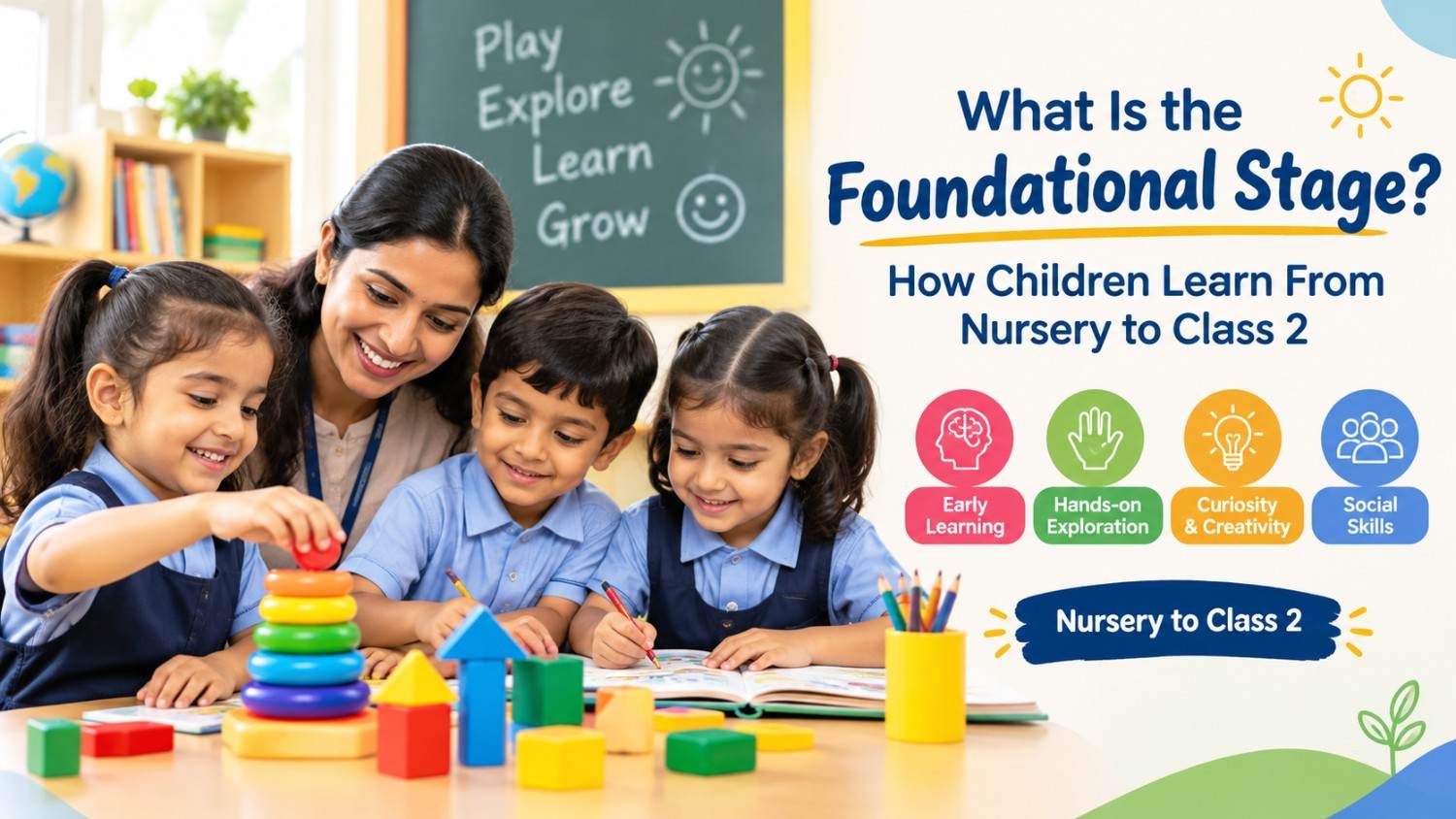
The Foundational Stage is the first phase of schooling under India's National Education Policy (NEP) 2020. It covers children aged 3 to 8 and lasts five years: Nursery, LKG, UKG, Class 1 and Class 2. In these years, children learn mainly through play, stories, songs, movement and hands-on activity instead of heavy textbooks and tests.
If your child is about to start Nursery, this is the stage that shapes how they feel about school for years to come. In this guide, Bajrang International School (BIS), a CBSE school in Greater Noida West, explains what the Foundational Stage is, how children learn at each age, and what you can do at home to help.
What Is the Foundational Stage in NEP 2020?
NEP 2020 replaced the old 10+2 system with a 5+3+3+4 structure. The Foundational Stage is the first "5": three years of pre-primary education followed by Classes 1 and 2. The policy notes that over 85% of a child's brain development happens before the age of six, which is why these early years get so much attention.
The goal is simple. Children should enjoy learning, pick up early language and number skills, and grow socially and emotionally. The National Curriculum Framework for the Foundational Stage (2022) turns this into practical guidance for schools, built around play-based and activity-based learning. Under the NIPUN Bharat mission, every child is expected to read with understanding and handle basic numbers by the end of Class 3.
Nursery to Class 2: How the Stage Fits a CBSE School
In a CBSE school, the five years usually look like this:
| Class | Typical age | Main focus |
|---|---|---|
| Nursery | 3+ years | Settling in, listening, speaking, sensory play |
| LKG | 4+ years | Letters and sounds, counting, fine motor skills |
| UKG | 5+ years | Early reading, number sense, pre-writing |
| Class 1 | 6+ years | Reading, writing, basic addition and subtraction |
| Class 2 | 7+ years | Fluent reading, place value, short writing |
CBSE refers to the three pre-primary years as Balvatika. Age cut-offs for admission can change, so confirm the current rules with the school's admission desk before you apply.
How Do Children Learn in the Foundational Stage?
Young children learn by doing. A four-year-old understands "more" and "less" faster while sharing blocks with a friend than while looking at a worksheet. Good early-years classrooms follow this natural pattern.
- Play-based learning: games, role play and building activities teach thinking, language and teamwork.
- Activity-based learning: counting with beads, sorting leaves or drawing a story lets children grasp ideas with their hands first.
- Stories, rhymes and songs: these build vocabulary, memory and listening skills.
- Home language: NEP 2020 encourages teaching in the child's mother tongue or home language where possible, since ideas are easier to understand in a language spoken every day.
- Observation over heavy testing: teachers watch, note and support each child's progress instead of ranking children by marks.
What Children Learn Year by Year
Nursery to UKG (ages 3 to 6)
- Language: listening, speaking, new words, pre-writing strokes, and letter-sound recognition by UKG.
- Numbers: counting, shapes, patterns and comparing sizes.
- Motor skills: holding a pencil, cutting with scissors, running and balancing.
- Social skills: sharing, taking turns, following routines and naming feelings.
Class 1 and Class 2 (ages 6 to 8)
- Reading and writing: reading with understanding, and writing short sentences and small paragraphs.
- Maths: addition, subtraction, place value and simple word problems.
- Understanding the world: plants, animals, family and community, introduced through activities and outings.
- Art, music and physical education: woven into the school day, not squeezed into the last period.
- Independence: asking questions, working in groups and taking small responsibilities.
Why the Foundational Stage Matters
Children who build strong reading and number skills early find every later class easier. A child who cannot read comfortably by Class 3 often struggles in all subjects, because later textbooks assume that skill. This is why schools and the government focus on foundational literacy and numeracy (FLN).
The emotional side counts just as much. A child who feels safe, noticed and curious in these years develops a confidence that carries into middle school. Our post on holistic development in education explores this link in more detail.
How Parents Can Support Learning at Home
You do not need special materials. Small daily habits make the biggest difference.
- Read aloud for 15 to 20 minutes every day, in whichever language you speak at home.
- Count everyday things together, such as stairs, fruits and toys.
- Let your child play, including outdoors, and skip the pressure for early writing.
- Ask open questions like "What do you think will happen next?"
- Keep fixed routines for sleep and meals, and limit screen time.
- Talk about the school day and listen to the answer, even when it is short.
Foundational Stage Learning at Bajrang International School
Bajrang International School is a CBSE school in Greater Noida West that teaches children from Nursery to Class VIII. Our early years follow the spirit of NEP 2020: activity-led teaching, warm classrooms and plenty of room to play and explore.
Your child gets access to our Campus facilities, including the library, labs and sports areas. Our student life programme adds art, sports and clubs, which support the all-round growth described in our curriculum overview. To see how extra-curricular activities help young learners, read our post on child development through extra-curricular activities, or find out why families choose BIS.
What to Look for in a School for the Early Years
- Classrooms where children move, talk, build and play, not only sit and write.
- Patient, trained teachers who know each child by name.
- A safe, clean campus with child-friendly spaces.
- Regular, open communication with parents.
- No pressure of heavy homework or early exams.
Foundational Stage FAQs
What is the Foundational Stage in simple words?
It is the first five years of formal schooling in India, designed around play and activity so that young children learn to read, count and get along with others.
What age group does the Foundational Stage cover?
It covers ages 3 to 8, which means Nursery, LKG, UKG, Class 1 and Class 2.
Is learning to write expected in Nursery?
No. Nursery focuses on drawing, tracing and pre-writing strokes. Formal writing grows gradually through UKG and Class 1.
How is a child assessed at this stage?
Mostly through teacher observation, classroom activities and portfolios. Heavy exams and ranking are avoided.
Which language is best for early learning?
NEP 2020 recommends the child's home language or mother tongue where possible, with English and other languages added step by step.
Does the Foundational Stage affect later results?
Yes. Strong early reading, number sense and confidence make learning in higher classes much smoother.
Give Your Child a Joyful Start
The Foundational Stage is about curiosity, confidence and strong basics, not about racing ahead. Choosing a school that teaches through play and activity gives your child the best possible start. To learn more about our early years, visit the BIS admissions page, contact us, or call +91 98702 61060 to plan a campus visit at Patwari, Sector-02, Greater Noida West.