


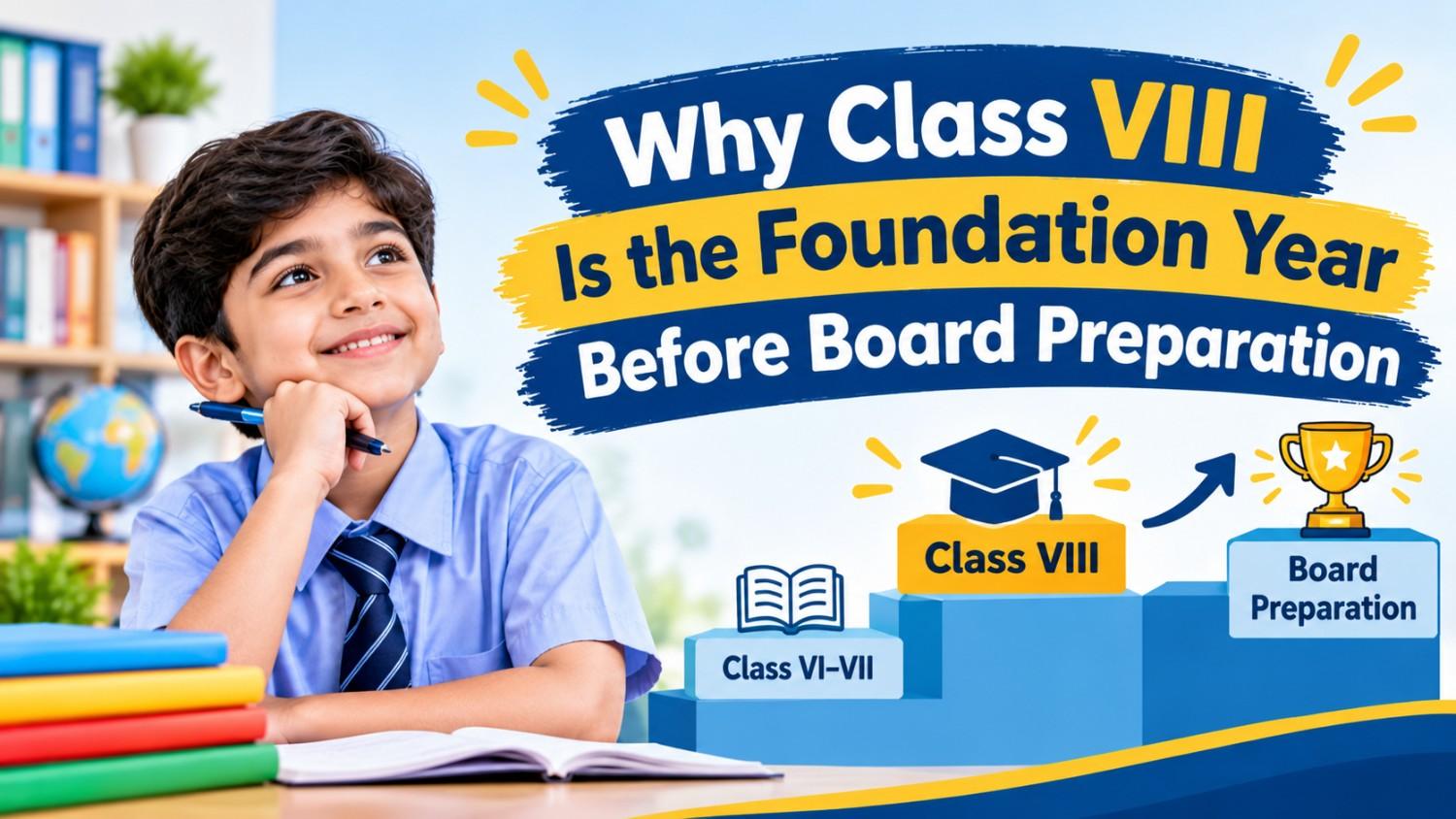
Quick answer: Class VIII is the last year of the middle stage in CBSE schools. It is the final chance to build strong concepts, study habits and confidence before Class 9, where the board syllabus begins. Children who use Class 8 well usually enter Class 9 calmer and better prepared. At Bajrang International School in Greater Noida West, we treat Class VIII as a bridge, not a break.
Many parents think board preparation starts in Class 9 or even Class 10. In reality, the marks your child scores in Class 10 are shaped by what happens two years earlier. This post explains why Class 8 matters so much, what changes next, and what parents can do now.
What makes Class VIII different from earlier classes?
Up to Class 5, learning is mostly about curiosity, language and basic numeracy. From Class 6, subjects become more distinct, with separate chapters in science, social science and mathematics. By Class 8, three shifts happen together:
- Concepts get abstract. Algebra, ratios, chemical reactions, force and pressure, and history timelines ask children to think, not just remember.
- Writing gets longer. Answers move from one-line responses to structured paragraphs.
- Independence is expected. Teachers assume a student can plan homework, revise on their own and ask doubts.
A child who struggles here often struggles silently. The gap then widens in Class 9, when the syllabus gets heavier and the pace increases.
Why Class 8 is the real foundation for Class 9 and the boards
1. Class 9 builds directly on Class 8 concepts
Mathematics is the clearest example. Linear equations, algebraic identities, mensuration and data handling in Class 8 return in tougher form in Classes 9 and 10. In science, the idea of matter, force and cells taught in Class 8 becomes a full chapter with numericals later. A weak base shows up quickly.
2. Study habits are easier to form now than later
A Class 8 child still has time. There are no board marks at stake, and parents can slowly introduce routines such as daily revision, a weekly planner and neat notebooks. Starting these habits at 13 is far easier than at 15, when pressure is high.
3. Language skills decide scores in every subject
Reading comprehension, writing and vocabulary affect performance in science and social science answers too. A student who cannot express an idea clearly loses marks even when the concept is understood. Class 8 is the ideal time to improve reading and writing.
4. Confidence is built here
Children who feel capable in Class 8 carry that belief into the next phase. Those who feel lost often decide they are "bad at maths" or "weak in science" and never fully shake it off.
What is changing in CBSE for Class 9 and beyond?
CBSE has announced changes to its curriculum from 2026-27, and they make Class 8 preparation more relevant, not less. Reports on the new framework highlight these points:
- A third language is being introduced in stages, starting from Class 6, with at least two of the three languages being Indian languages.
- Class 9 students can choose an advanced level in mathematics or science alongside the standard course.
- Computational thinking is being woven into Classes 3 to 8, with structured modules in later classes.
- More weight is given to internal assessment and skill-based subjects.
- CBSE also now offers two Class 10 board exam sittings, which makes steady, concept-based learning more valuable than last-minute cramming.
The framework is still evolving, so parents should confirm current details with the school. The direction, however, is clear: boards will reward understanding, application and consistency. We have written about this shift in our post on why skill-based education matters in 2026.
How Bajrang International School prepares Class VIII students
Bajrang International School is a CBSE school in Sector 2, Patwari, Greater Noida West, teaching from Pre-Nursery to Class VIII. Our middle school approach rests on a few ideas.
Concept first, then practice. Teachers explain the "why" before assigning questions. Smart classrooms help show ideas visually, and our science, STEM and innovation labs let students test them hands-on.
Small classes. With a maximum of 28 students per class, teachers can notice who is stuck and step in early.
Regular, low-pressure assessment. Frequent short tests help us spot gaps in time, without turning every week into an exam week.
Skills beyond textbooks. Robotics, AI exposure, sports, arts and drama build communication, teamwork and problem-solving. Research on extra-curricular activities and child development shows these skills support academics, not compete with them. Our approach to holistic development in education explains this further.
A learning journey that began early. The habits seen in Class 8 start in the early years. If you have a younger child, read about the foundational stage from Nursery to Class 2.
You can see how we teach on our academics page and how students spend their days on the student life page.
Practical tips for parents of Class 8 students
You do not need to push harder. You need to guide smarter.
- Check the basics in maths. Fractions, percentages, integers and simple algebra should feel comfortable. If not, revise them now.
- Fix a daily reading habit. Twenty minutes of a newspaper, story or science article builds vocabulary and comprehension.
- Make a simple weekly timetable. Let your child help make it, so it feels owned and not imposed.
- Review notebooks together once a week. Look for neatness, completed work and teacher remarks.
- Encourage questions. A child who asks "why" learns faster than one who only memorises.
- Protect sleep and play. A tired child cannot concentrate, and sport improves focus.
- Talk to teachers early. Do not wait for the annual report card. Our annual planner lists parent-teacher meetings and key dates.
- Avoid comparison. Every child grows at a different pace. Compare today's work with last month's work, not with a neighbour's child.
Signs your child is ready for Class 9
- Solves new problems without needing the exact example shown first
- Writes answers in clear, organised sentences
- Manages homework with little reminding
- Asks for help when stuck
- Feels curious, not afraid, about the next class
If a few of these are missing, that is normal. Class 8 is exactly the year to work on them.
Frequently asked questions
Is Class 8 important for CBSE board exams? Class 8 has no board exam, but it is the base for Class 9 and Class 10 content. Strong concepts in mathematics, science and language make board preparation much easier later.
When should board preparation start? Serious revision belongs to Classes 9 and 10, but the groundwork of concepts, habits and confidence begins in Class 8.
How can parents help a Class 8 child with the Class 9 transition? Strengthen maths basics, build a reading habit, set a routine, stay in touch with teachers and keep the child's stress low.
Does Bajrang International School teach up to Class 8? Yes. We teach from Pre-Nursery to Class VIII, and our middle school programme is designed to prepare students for the move to Class 9.
Is Class 8 too early to worry about marks? Marks are not the goal here. Understanding and good habits are. Focus on those and the marks follow.
Ready to give your child a strong start?
If you are looking for a CBSE school in Greater Noida West that treats middle school with care, we would be glad to meet you. You can apply through our admissions page, read what parents say, or visit us at Patwari, Sector 2, Greater Noida West, Uttar Pradesh 203027. Call +91 98702 61060 or write to bajrangschool.enquiry@gmail.com through our contact page.